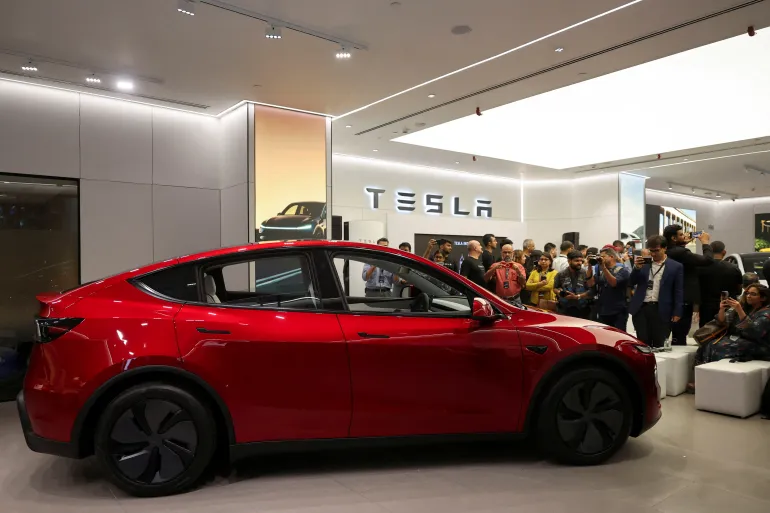
Tesla reported a solid rise in third-quarter sales as American buyers rushed to purchase electric vehicles before federal tax credits expired at the end of September, a change brought by President Donald Trump’s new tax legislation.
The automaker delivered 497,099 vehicles in the quarter, up 7.4 percent from 462,890 a year earlier. The bulk of deliveries came from the Model 3 sedan and Model Y crossover, which together reached 481,166 units, beating Wall Street forecasts and underscoring strong short-term demand.
The sharp increase was fueled by the final window for consumers to benefit from the $7,500 EV tax credit. Tesla highlighted the deadline in its marketing, combining it with discounts and financing packages to accelerate orders. Analysts, however, warn that demand could soften now that the incentive has expired.
“While the third quarter was strong, we expect fourth-quarter sales will decline, largely due to the US tax credit expiration,” said Seth Goldstein, senior equity analyst at Morningstar.
To meet its 2025 delivery target of 1.61 million vehicles—about 10 percent lower than last year’s output—Tesla will need to sell nearly 390,000 vehicles in the final quarter of the year, a challenging prospect without the support of federal subsidies.
In China, Tesla began deliveries of the long-wheelbase, six-seat Model Y L, aimed at family buyers in the world’s largest EV market. The launch is seen as an effort to strengthen Tesla’s foothold in China as competition intensifies.
Europe, however, remains a weak spot. Tesla’s sales in the region, including the UK, dropped 22.5 percent in August, cutting its market share to 1.5 percent. Traditional automakers have gained traction with plug-in hybrids, while Chinese EV brands continue to expand aggressively.
Looking ahead, Tesla is betting on more affordable models to cushion demand. A pared-down version of the Model Y, designed to be about 20 percent cheaper to produce, is expected to begin rolling out in China and Europe before reaching the US market. Analysts estimate the variant could scale to 250,000 units annually in the US by 2026, helping Tesla regain momentum after the loss of tax incentives.
“The challenge now is dealing with the slowdown that follows, and that’s where a new, more affordable model becomes crucial,” said Matt Britzman, senior equity analyst at Hargreaves Lansdown.
Tesla’s performance continues to drive CEO Elon Musk’s vast personal wealth. A recent rally in Tesla shares lifted his net worth past $500 billion, cementing his position as the world’s richest individual.
The company’s board has also proposed a new CEO compensation package that could be worth up to $1 trillion, tied to performance and valuation milestones over the next decade. If approved, the plan would grant Musk about 12 percent of Tesla’s equity, underscoring investor confidence in his long-term vision.
Beyond cars, Musk has sought to position Tesla as a technology company with growing investments in artificial intelligence, self-driving systems, robotaxis, and humanoid robots.
Tesla will release its detailed quarterly earnings on October 22, a report closely watched by investors as the company faces the challenge of sustaining momentum in a post-tax-credit market.